
Recently I had an intense discussion about a game’s flow. Being a game designer, I expressed strong opinions on how a game’s flow should be implemented. I won’t disclose the outcome of the discussion because it has nothing to do with Legions of Kadmon. However, profound discussions usually got me thinking about my own game. “Did I implement the things I’ve claimed should be implemented? Or am I just a hypocrite?”
That’s the reason I’m writing this log. I want to revisit the evolution of Legions of Kadmon’s flow from its concept phase until now. Call it self-reflection. Though, I hope it teaches my constant reader a little bit more about the Magna Cycle — the phases that dictates how Legions of Kadmon flows.
“Why is This Game So Complicated?”
“Why is this game so complicated?” is a question I often received during the early development stages. And for a newbie designer, this question is very misleading. Having my platesters calling the game complicated often led me to think that I need to dumb down the mechanics of the game. It often led you to believe that the right way to proceed is to simplify the effects of cards. But what this often leads to is a monotonicity of effects. It can get a little suffocating, trying to keep the game dumbed down.
Eventually, I realised that the biggest contributor to a complicated game is a murky game’s flow. The more players need to figure out what to do in an instance of the game, the more ‘complicated’ the game becomes. To help with that, I need to make sure that a player’s mind can go into an automated state as fast as they can. To do this, I introduced a concept of symmetry and regularity.
Symmetry of the Magna Cycle
Every phase in the Magna Cycle can be summarised into a few words.
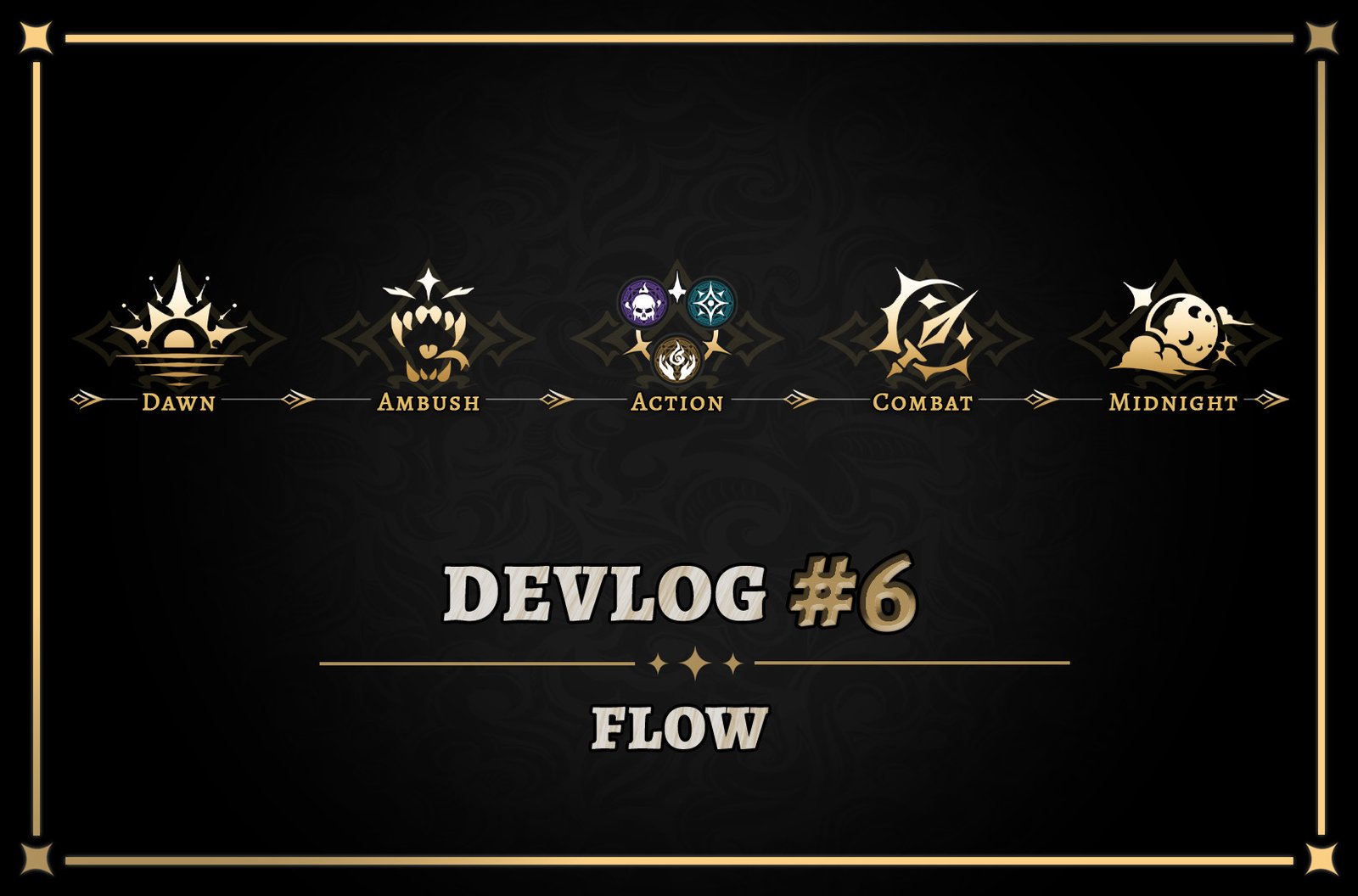
- Dawn: Resolve ‘Dawn’ Effects. All players restore their Action Token.
- Ambush: In a direction, one by one, one card from the Wilds enters the player’s Legion.
- Action: In a direction, one by one, players perform actions.
- Combat: In a direction, one by one, players resolve combat.
- Midnight: Resolve ‘Player’s Death’. Remove Shields. Pass the Sigil.
If you haven’t noticed, there’s a trend on the Magna Cycle:
Global Triggers -> Sequenced -> Sequenced -> Sequenced -> Global Triggers
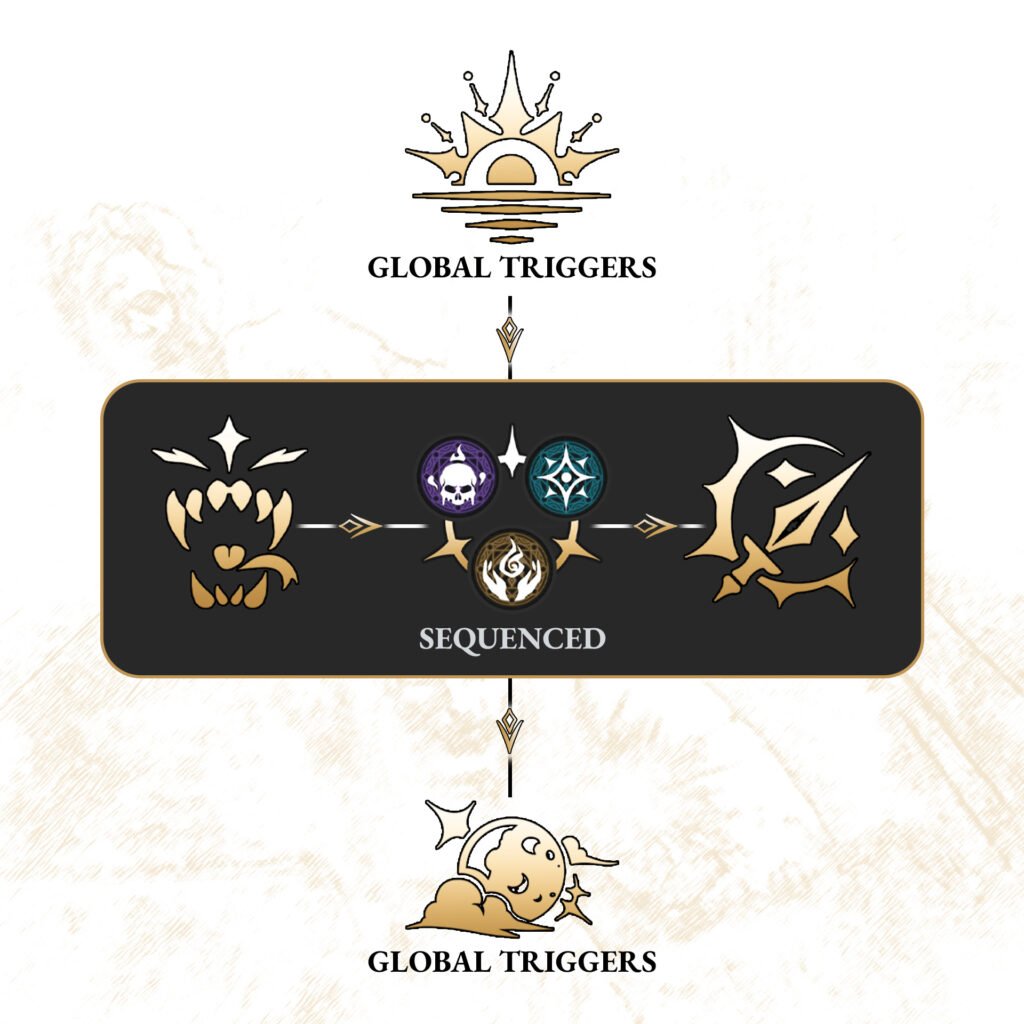
By placing all Global Triggers on the beginning and the end of the Cycle, players need not worry about missing an effect in the middle of their ‘turn’. It might not sound like much, but it actually removes a LOT of mental stack on players. This way, players can focus on their actionables. Having the symmetry of triggered effects only at the beginning and the end helps remind players to check for these triggers at the beginning and the end. Also, because Cycle loops, having triggers occur at the beginning and the end organises the player’s mind.
When it’s time to do actions, I don’t need to care about triggers.
When triggers happen, I just need to lean back and let it play out.Placing Sequenced routines back to back in the centre introduces regularity and helps players to understand the game’s flow. This is the part of the game that the players will spend most of their time in. Three consecutive phases with the same repeated routine of ‘in a direction, one by one’ helps players to feel the game’s flow quickly. I aim to have players understand what to expect by the second Cycle. And only when the players get the feel of the flow, I will start throwing curve balls to spice things up. You ‘dumb the game down’ not by removing the complexity of effects, but by training the players to understand what to expect by repeating phases’ structure.
History & Challenges
Settling down on Legions of Kadmon’s flow is harder than balancing the cards or making the game’s core mechanics work. Getting the right flow also means reducing the game’s length and making the game feel good. And… honestly… that’s a bigger factor in making a game fun than balancing. I had to change and remove a lot to make this game work. But those tribulations taught me a lot about game design, and without it, I won’t be writing this log now.
Sovereign Ambushes
Early Legions of Kadmon wasn’t exactly a Boss Rush. There was no Ruling Sovereign in the centre of the board for everyone to fight. Instead, Sovereigns appear from the Wilds through the Ambush. They enter a player’s legion and trigger their calamity only on that specific player.
There are two major problems with this. First: it’s unfair for the ambushed players. Second, and more appropriately for this log: it disrupts the flow of the game. When a Sovereign ambushes a player, the game halts on that specific moment and any triggers must be resolved before continuing.
But, doesn’t the current calamity work the same way?
Yes, but most of the time it only happens once in a single Cycle. Sometimes, it didn’t even happen at all. Back then, it was possible to see two disruptions happening in a single ambush. The bigger problem is the phase the disruption occurs on. Ambush is the simplest phase in the game. A no brainer phase where players are meant to only wait for an incoming unit. In fact, if we want to compare it to MTG, the Ambush Phase is essentially the game’s draw step.
To have an effect triggered during the draw step is absurd, and there is a quick 0 to 100 shift in the player’s brain activity which makes it easier for abilities to miss-trigger. The brain might not be warm enough to perceive an effect triggered on the ‘chillest’ phase.
The Curse Phase
There was an additional phase that happened between Action and Battle. The Curse Phase was a step in the game where a card would be revealed from the top of the Wilds. Then, the Legion would cast that card as a Spell, targeting the player with Kadmon’s Sigil.
The first immediate problem with this is the restrictions it imposed on Spell design. Because to have a Legion-castable Spell, I must make sure that the Spell Effect is symmetric. Which wouldn’t work with many of the Spells you find in the game now.
For example, Ungrave wouldn’t work for Legion-castable spells because the Legion has no hand.
This first problem led me to put the Curse Effect on the Ruling Sovereign instead. It added more character to each Sovereign and it reduced the randomness of the game. For a while, I was pretty content with this… until I realised…
Even though it is a Phase in the game, many of my playtesters forgot to execute the Curse or take account of the Curse’s Effect when they performed their Actions.
There were two things I could blame on. First: this curse only affects players with the Sigil. Because the Curse happens only to players with the Sigil, this means they should only care about it every 4 Cycles. Most of the time, players will not be affected, and they’ll forget about it. Second: it happens right before the Cycle’s payoff. Combat Phase in Legions of Kadmon can be considered as the Cycle’s payoff. This is the phase where players can see the outcome of the choices they made through their Action. Players are excited to get into Combat, and so they don’t really pay much attention to that one effect before combat.
I removed the Curse Phase entirely. Instead, I put the effect on Dawn Phase. Do people still forget about it sometimes? I’m afraid they do, but it almost never happens because it’s the first thing that happens in a Cycle. After adjusting the Dawn Effect to affect all players, the miss-trigger happens even less often. After all, the players will begin to remind each other of the nasty things the Ruling Sovereigns will do to them (I’m talking about you, Ianira. Hehe).
Triggers Everywhere
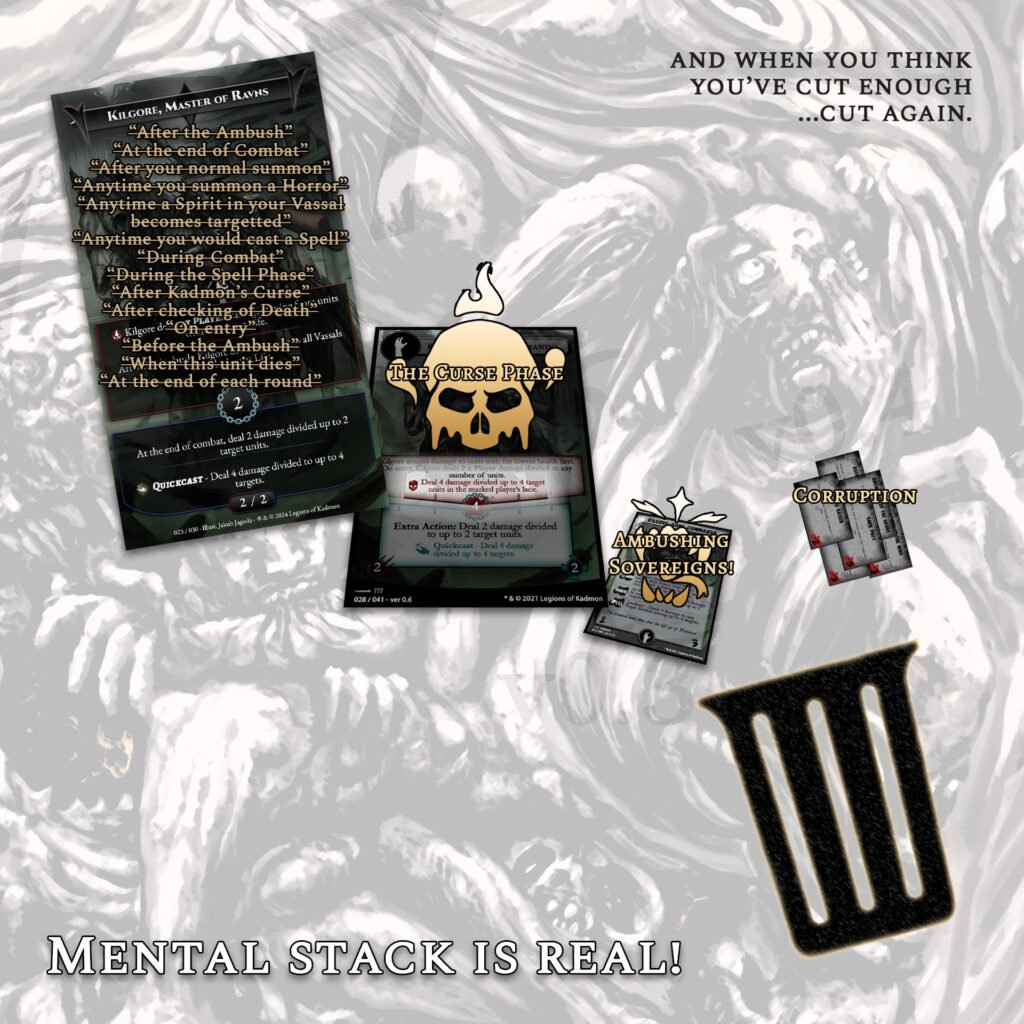
Before settling with At Dawn effects, I used to have effects occurring everywhere throughout the game. Kilgore’s Ruling Sovereign’s effect, for example, only happens after the Ambush. There are also Ruling Sovereign effects that trigger At Midnight. Embracing my TCG player spirit, I genuinely thought that this was cool. I have a variety of effects that happen at different phases of the game. It injects the Ruling Sovereign with so much character!
Well… NOBODY REMEMBERS TO TRIGGER IT!
Even when I am a game master, hosting playtests and teaching new players, I often find myself forgetting to trigger abilities. There are just too many things to take note of. Mental stack is very important to take note of!
I restricted myself to applying these triggers at Dawn. After imposing myself with this restriction, I was surprised that it is actually quite simple to achieve the same effect by wording the effects in a different way. Furthermore, there are some abilities that don’t even matter if it happens after an ambush or at Dawn.
Promise, Progress, and Payoff
Brandon Sanderson — my favourite author — had a series of lectures held in BYU. In one of those lectures, he talked about Story Structure which can be simplified into a sequence: The Promise -> The Progress -> The Payoff. I believe that games tell stories (otherwise people won’t ask what the game’s all about). A story structure can be applied to the construction of a good game flow.
We can divide this into the unit flow and the overarching flow. A unit flow dictates the flow of the game in its repeated sequence — in the case of Legions of Kadmon, a Magna Cycle. An overarching flow will dictate the flow of the game from start to end.
Plot Structure to Understand the Magna Cycle
Every Cycle begins with a Promise to all players. “Hey, in this Cycle, you will secure some points!”. How do the players do that? Well, at Dawn, your Action Tokens are replenished. You now have the resources to secure these points. The next question will be: what are the players going to do with it?
Our story continues with the first challenge faced by the players. The Dawn Effect. It triggers and sets the player back. This is followed by an Ambush which puts our hero (the players) at a greater disadvantage. This is the conflict of our story, and conflicts incite progress.
The Ambush Phase, however, is not the only conflict. Every action taken by the players is a form of progress because it introduces more conflict for the remaining player.
Player 1 takes his turn and changes the board state. Player 2 – 4 feels threatened because the advantage skews against them (conflict). Player 2 takes an action and once again changes the board state (more conflict is introduced). This continues to Players 3 and 4.
The Progress in this case happens during the Action Phase. And culminates into a Payoff that resolves itself during the Combat Phase. Immediately, players will see how their actions bore a result. Then, comes Midnight which concludes the story, cleans up, and sets up a new one.
Repeat.
Plot Structure to Understand the Game!
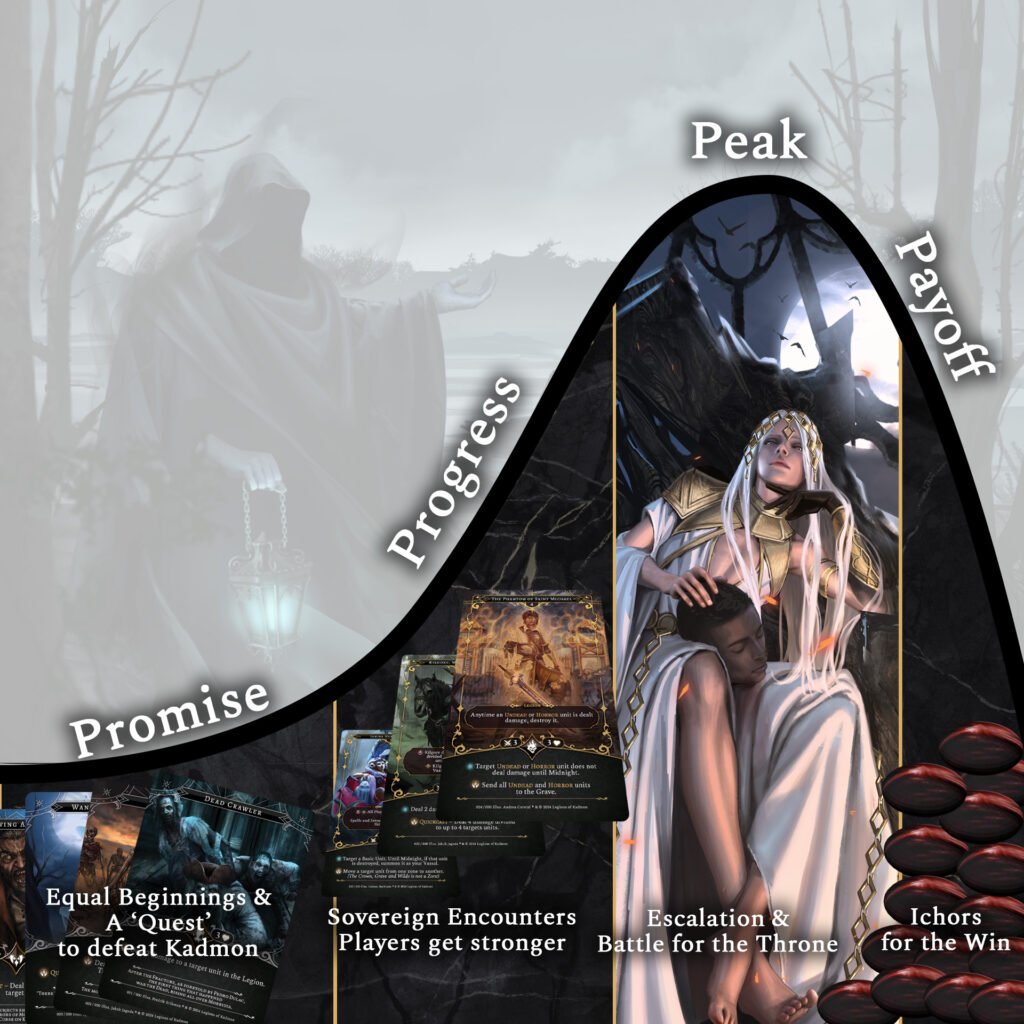
Without Plot Structure, your game’s premise will be minimal and answering the question: what’s your game about? Will become a much harder task. When I first conducted a public demo for the game back in June, I had some trouble finding the right words explaining the game. It was difficult to gather my thoughts because I felt that there are a lot of things to explain. After some self-reflection, I realised that it would be easier to think of the entire game as a Plot.
Packaged as a game, Legions of Kadmon began with a promise: You are a Death Summoner. You venture into Morbidia to usurp Kadmon from his throne. But a throne cannot be shared. This promises players a few things:
- You are a Death Summoner -> “Oh, my power has something to do with the Dead? Necromancy?”
- You venture into Morbidia to usurp Kadmon from his throne. -> “Who is Kadmon? And we are supposed to defeat this Kadmon fella?”
- But a throne cannot be shared -> “So, the game has only one winner!”
These promises helped ease a player’s understanding when explaining the game. Point 1 helped me convey the core mechanic of killing a unit means obtaining that unit. And it also explains the Dark Fantasy theme of the game. Point 2 helped me convey the genre of the game. Legions of Kadmon is in fact: a boss rush that ends when the final boss (Kadmon) is defeated. Point 3 helped me convey the true goal of the game — to be the one who replaces Kadmon by collecting the most Ichor (VP).
Progress is also an important part of the game. As a game proceeds, it is important to keep players feeling that they are making some progress. And this can be done through conflict and change. A conflict serves as a challenge, and an increasing challenge shows that there is progress going on in the game’s session. In Legions of Kadmon, the increasing challenge is the state of other players, particularly, the size of the Collected Ichor. A change ensures a tonal shift throughout the game. This also gives an impression of progress. Legions of Kadmon uses the Ambush phase and its core mechanic to achieve this. Ambush increases the pool of available cards a player can use, and that keeps on increasing until the game’s end. The mechanic of kill to obtain allows players to eventually obtain a Sovereign, which gives them the impression that they have leveled up.
This goes on until it culminates into the payoff. The Final Battle.One of the most important aspects a game should have is momentum because it ensures the game’s end. If a player thinks that a game will not end, then they’ll give up trying in the middle. The payoff and a game’s momentum work hand in hand. The Final Battle in Legions of Kadmon serves as the story’s climax. It is short, intense and significant enough to change the course of the game. It is a gameplay beat where players can finally show off the units they have collected throughout their adventure. This is the very reason why I introduced a Wild Action Token and increased the player’s hand size by 1. It raises urgency and delivers a sensation that resembles the climax of a novel.

Leave a Reply