
Let’s talk about something more intricate when it comes to Game Design. What does ‘Balance’ even mean? What makes a game ‘balanced’? And why is having a ‘balanced’ game so important?
Developing Legions of Kadmon, I constantly put myself in pursuit of this mythical golden goose of a perfect game with an equal chance of winning. That the only thing that matters when it comes to winning is an individual’s skill level. I’ve got to admit, I grew up playing a lot of competitive games. There was just something about it that brought an insatiable thrill, especially for zealous youths. For a very long time, I was obsessed with the idea that every game should reflect an expression of a player’s skill.
So what happens when I throw myself into a game filled with randomness? I panic. I felt that there was no solution. That a game with randomness was a waste of time to play and develop. For a long time, overcoming this notion was my biggest challenge when it comes to developing Legions of Kadmon. But as time passed, and as I played more chill Indie Games that told incredible stories, my perspective game design grew.
This Developer’s Log will cover some of my decisions to improve the concept of game balance in a game filled with randomness. There will be a common theme throughout each section, that is: Control what you can control, and what you can’t are just elements of fun.
Cheers! This article might also give you a little bit more tricks to use when playing Legions of Kadmon.
Card Power Level
Let’s start with the most obvious one. Each card in Legions of Kadmon can be considered an individual building block. Every card defines what you can do as a Player and how you play every card can decide your experience playing the game. Depending on how powerful one card is compared to another, it’ll affect the smiles and the frowns around the table.
Attempt 1: Balancing by Unit Type
When I first started developing the game, the most obvious thing to do was to design the cards to follow themes. And the most obvious theme to follow would be the Unit Type. In the beginning, my design principle for each cards would be something like:
- Undead Cards – Moderate Unit, Moderate Spells.
- Spirit Cards – Weak Units, Strong Spells.
- Horror Cards – Strong Units, Weak Spells.
It was a disaster.
During our first playtest, some of the players expressed their concerns on specific cards. But most of them agreed that it became obvious that one Unit Type is way stronger than the other.
“There is no point in pursuing the Spirit bonus because my Spirits die way too easily.”
“Horrors are way too strong. It doesn’t even make sense to discard them as a Spell.”
“Maybe you can consider the Horrors to be a vanilla creature (can’t be played as a Spell) and force Players to only play them as a Unit.”
My reaction to this was to adjust the strength of each Unit Type Bonus. I made the Spirit bonus extremely strong, that way it encouraged players to make the attempt to pursue the bonus despite the weaker units. And conversely, I made the Horror Bonus weak.
On paper it seemed to be a nice solution. It gives the Spirit players a bigger risk and reward when completing the set. It makes the Horror players play a safer yet consistent route. Yet, after another test, another set of complaints came.
“I don’t want to have a Horror as my attacking Legion, it’s stupid. They’re too strong.”
“Spirits are still jobbing (it’s a wrestling term). And the risk of getting a Spirit bonus is way too big.”
“Actually, I think Undead is the meta.”
Attempt 2: Unit Type for Spell Type
As I playtest more of the game, I’ve realised that the main spell mechanics revolve around three things. Removals, Sustains, and Bolsters. I decided to use the theme for the design of the spells instead.
- Undead – Removals
- Spirit – Sustain
- Horrors – Bolster
Yet another disaster. Why? Because while tying a mechanic to unit types is really cool, I failed to notice that each mechanic is more versatile than the other. Bolster based mechanics, for instance, are useless when you have no Vassals. The same could be said for Sustain based mechanics, though they were less punishing. Are they needed? Yes. Are they powerful? In certain scenarios. But given the versatility of Removals, the other two pale in comparison.
This brings me back to the same problem. Some cards are useful, some cards not so much. The worst part about it was that it completely removed the illusion of choice Players have for some cards. There were still many moments that Players would tell me “I don’t see the point of playing this card as a Spell.” or “This card cannot be summoned as a unit.”
It brought me back to the drawing board. I realised that there is a connection between Units and Spells that I failed to see. And if both Unit and Spell are measured in an individual scale, the two must be connected in a more intricate way than I imagine.
Attempt 3: Unit Rating Valuation
Unit Rating Valuation is a theoretical design term that I used when designing the cards. It is my attempt to quantify the value of a card based on the stats they have. I came up with this system after a series of playtests, settling on the valuation of each stats only after observing card effectiveness.
The first part of this valuation is the Stats Rating which is how I would rate the strength of a unit as a Vassal or when encountered in the Legion. My rule for Stats Rating is pretty simple. Here’s a snapshot from my documentation:
The second part of the Unit Rating Valuation is the Spell Rating which is how I would rate the strength of a Spell. This is mostly done under my discretion, usually based on observations from playtests. But I do still have a rule on how much each effect would cost. For example, a spell with a 1 Damage would rate as 1.5 because it takes away 1 Life. Additional clauses like Quickcast contributes 1 point. Spell targetting also becomes a factor to the Spell Rating.
The idea is: If I know each unit’s valuation, I can balance the cards.
So I give myself a rule: Each card can have a total rating of 15. Starting hands have a total rating of 10. Then, I’d use those numbers as a basis to design the cards so that no one card is too powerful.
Playtest and playtest again. I came up with 2 outcomes. Good news and terrible news. The good news is, by using Unit Rating Valuation I cancontrol the distribution curve, something that helped me with controlling the randomness of the game (see next section). The bad news is, it does not solve my problem at all. The same concerns still came in: “I don’t see the point of playing this card as a Spell.” and “This card cannot be summoned as a unit.”
But with Unit Rating Valuation, I could see cards with numbers attached to them. And with that, something clicked. I’ve been designing cards based on what I would expect a TCG card would be designed for. But it is very rare for TCGs to have a card representing both Units and Spells. Usually those two are separate entities. It was this very mechanic that had been giving me problems. I failed to see that the relationship of Units and Spells is not an inverse relationship but a direct relationship.
Spell and Unit Duality
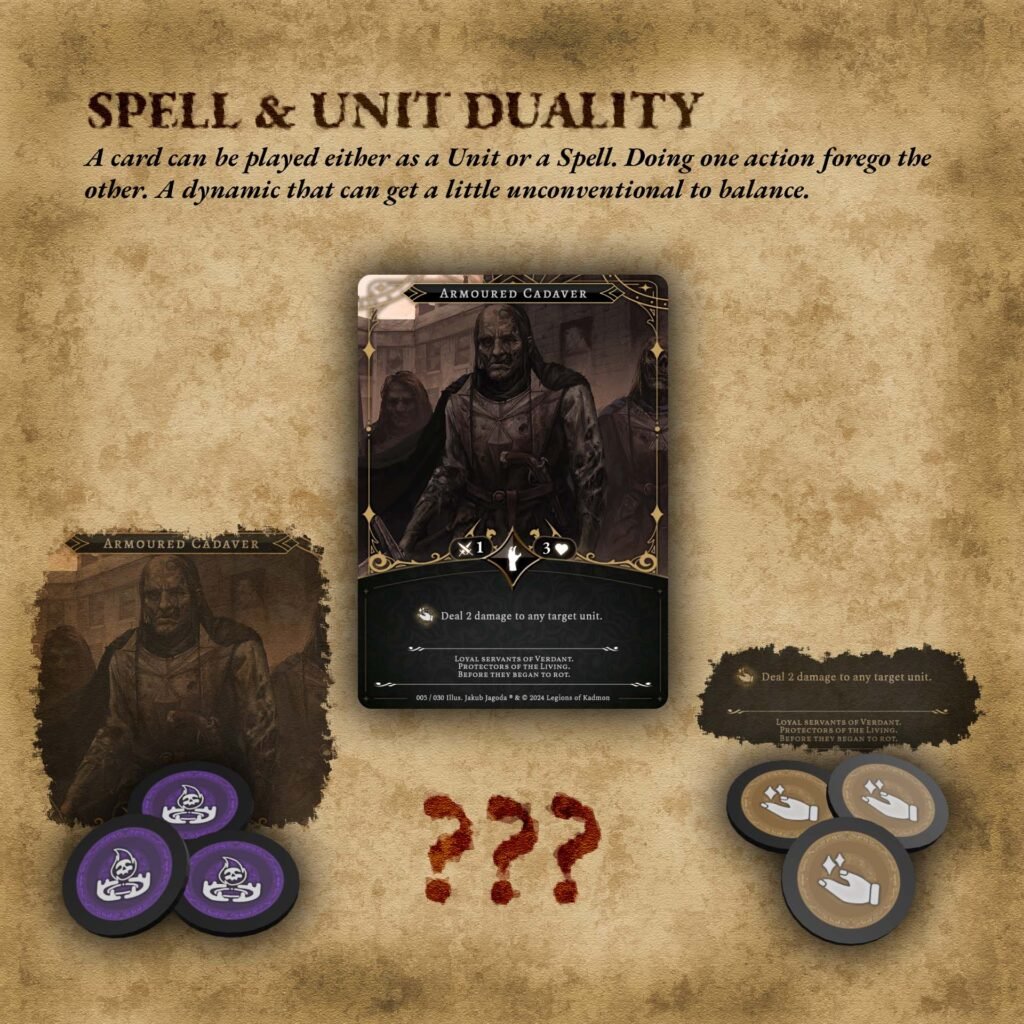
In TCGs, there is a resource, a cost and a reward. In Legions of Kadmon the resource is the amount of Actions you can do in every cycle. The reward is either the unit you summoned as your Vassal or the effect from the spell you’ve cast. What about the cost? For many games, the cost for performing an Action was pretty clear. For example, in Magic and Hearthstone, there’s thespell’s mana cost. In Yu-Gi-Oh, there’s the offering cost. For Legions of Kadmon, it’s just the action charges and one card from your hand. OR IS IT? From the many iterations of playtests, I failed to understand the cost completely. There wasopportunity cost incurred and it was something I didn’t take account of.
The Opportunity Cost. This cost is caused by the Spell and Unit Duality mechanic I have for every card. What is this duality? When a Player choose a card to cast a spell, they can never use the same card for a Summon action. And that act of foregoing one action for the other serves as a cost.
By understanding the Spell and Unit Duality – how choosing one action will incur a cost by foregoing the other – it became clear where the design flaw lies. To present Players with the illusion of choice between Spell and Units, the power level of both aspects must be equal. If a card represents a strong unit, then it must also represents a strong spell. When a Player chooses to use a card to Summon a powerful unit, they must forego their opportunity to Cast a powerful spell. The reverse is true.
This understanding solves a lot of issue. Every card now seemed useful in all aspects. Now, a Player must bear the cost of actually discarding a Unit to the Graveyard when they wish to cast a powerful spell. With this, I also managed to solve the problem of encountering unfair Legion units. How so? When a Player encounters and defeats a stronger Legion units, they are also given the ability to play stronger spells that could change the state of the game.
Controlling Randomness
For many years, I hated randomness in my games. In a strategic game, it almost defeats the purpose of strategising at all. Yet, when you sit down and observe all the games you’ve played, you will realise that randomness is inevitable. Randomness will always be there to spice things up. It is the factor that made a game fun. It is the factor that adds variation to the game and its outcome.
The right question to ask yourself is not “How do I get rid of randomness?” but “How do I control randomness?”
The cool thing about being a gamer is that you get to learn a lot of different things from different genres. So in the context of randomness, I’d like to provide some cases that I’ve observed as I’m playing games from other genres.
Case 1: Deckbuilding
The most obvious genre is TCGs. Which aspect of TCG allows Players to control randomness? Deckbuilding. This notion became very obvious in TCGs like modern Yu-Gi-Oh!
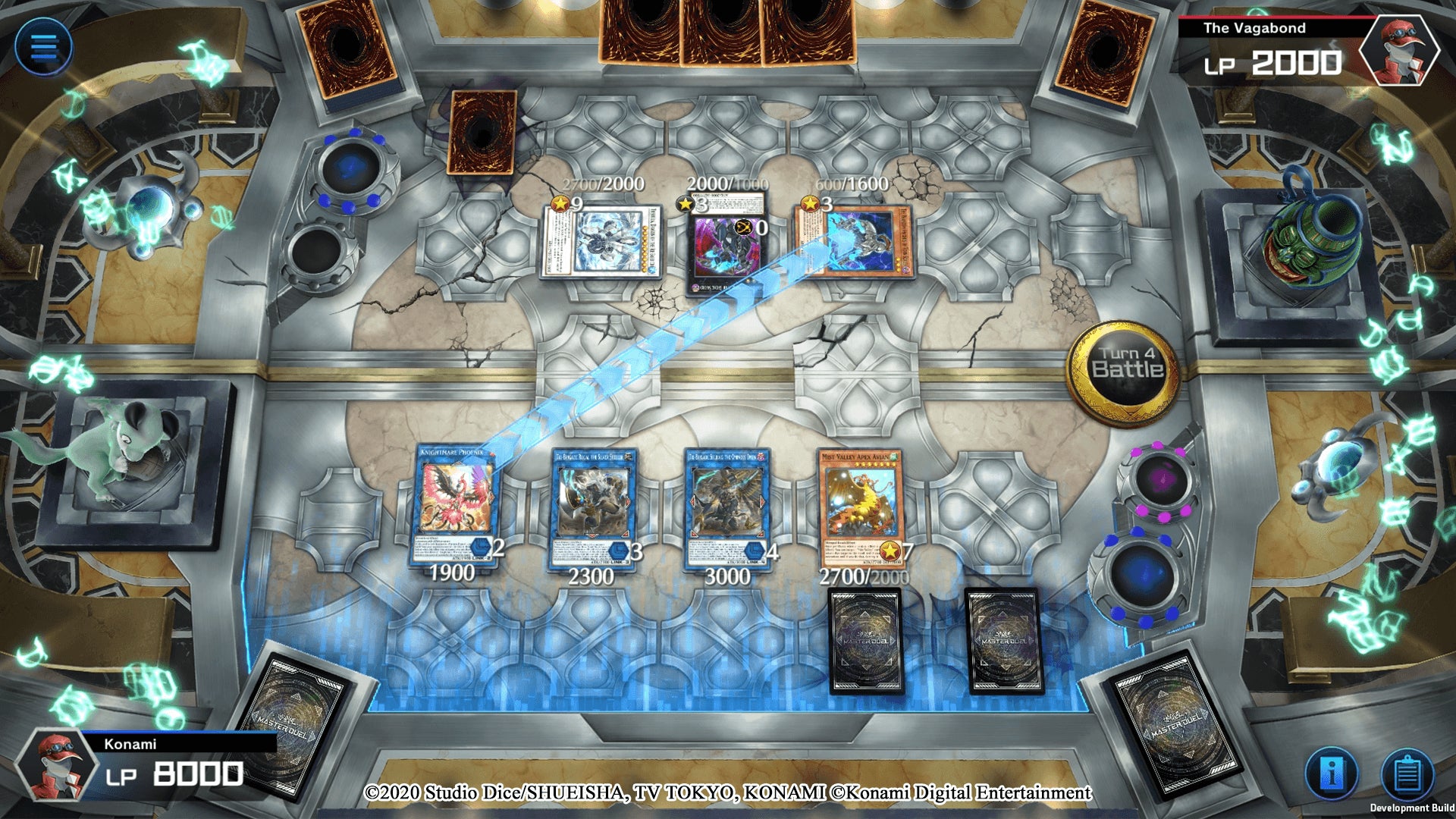
Yu-Gi-Oh! is a very weird TCG. Most of Yu-Gi-Oh! games will end in the first two to three turns. Some games even ended on the first turn. It is a game where all the decks involved are essentially… combo decks. And I often wonder, “what’s the fun in that? What’s fun about looking at a Player, playing solitaire for 10 minutes a turn?
Well the fun actually comes in the Deckbuilding aspect. Building a deck in Yu-Gi-Oh! is managing risks on steroids. What are the chances that my deck failed? How can I improve these chances? The goal in Yu-Gi-Oh! is to get from state A to B in a single turn. The stronger your final state is in the turn, the less likely you’ll lose the game. The rest of the turns were improvisation. To achieve this, a Player needs to calculate: what are the chances I draw all my engines in the first draw? What are some tools I can use to get my engine running? What are the chances I ‘bricked’ on the first draw? And all this can be done when a Player knows what is in their deck.
And in essence, I can treat the Wilds as such. Knowing that Legions of Kadmon isn’t a deckbuilding game, I often forgot that the responsibility to build a deck is now given to me. And that deck would be the Wilds. Treating it like deck building made it easier for me to decide how many Units I want to have in the game, and how I want to distribute it. I can also gauge how I want the game to be played: Would there be a lot more removal spells involved? Would the game orient itself more towards sustaining the board? I began to look less into individual spell design but more towards how effects and encounters are being distributed.
Case 2: Coup de Grace
Or in a more general term: Critical Hit.

Critical Hit is a very common mechanic being used in various games. Getting a critical trigger can be very satisfying. And among the many different games and characters that revolve around the critical hit mechanic, one I could think about is Phantom Assassin with Coup de Grace from DOTA.
The concept of critical hit oozes randomness. After all, these ultra-damaging attacks happen at random. Right? Well… not exactly. Every critical hit is usually accompanied by a critical rate. It is simply the probability of landing this critical hit. What’s so unique about critical rates is the fact that it gives a quantifiable number to randomness. This number becomes the basis for Players to increase the rate of hitting that desired outcome out of the randomness. In the case of Coup de Grace, Players will increase Phantom Assassin’s attack speed to increase the chances of hearing that dopamine-inducing blood spurt sound.
So… why are we talking about critical hits again? It is to give us assurance that, if somehow we can give a quantifiable number to measure randomness in Legions of Kadmon. Then, we can adjust how random the game can be through different means.
Distribution Curve
The cases I’ve mentioned above are only some among the few. Though, even from these three examples, there was one common trend that you might have noticed. Randomness is not very random after all. Randomness is governed by probabilities which, as proven by many statisticians and actuaries, can be controlled. This can be observed and manipulated through a distribution curve.
In order for you to generate a distribution curve, you will need to determine the sample model and a base parameter. In the case of Legions of Kadmon, the sample model would be the Wilds: which is essentially a deck of cards that acts as a threat and resource for the Players. As for the base parameter, remember the Unit Rating Valuation?
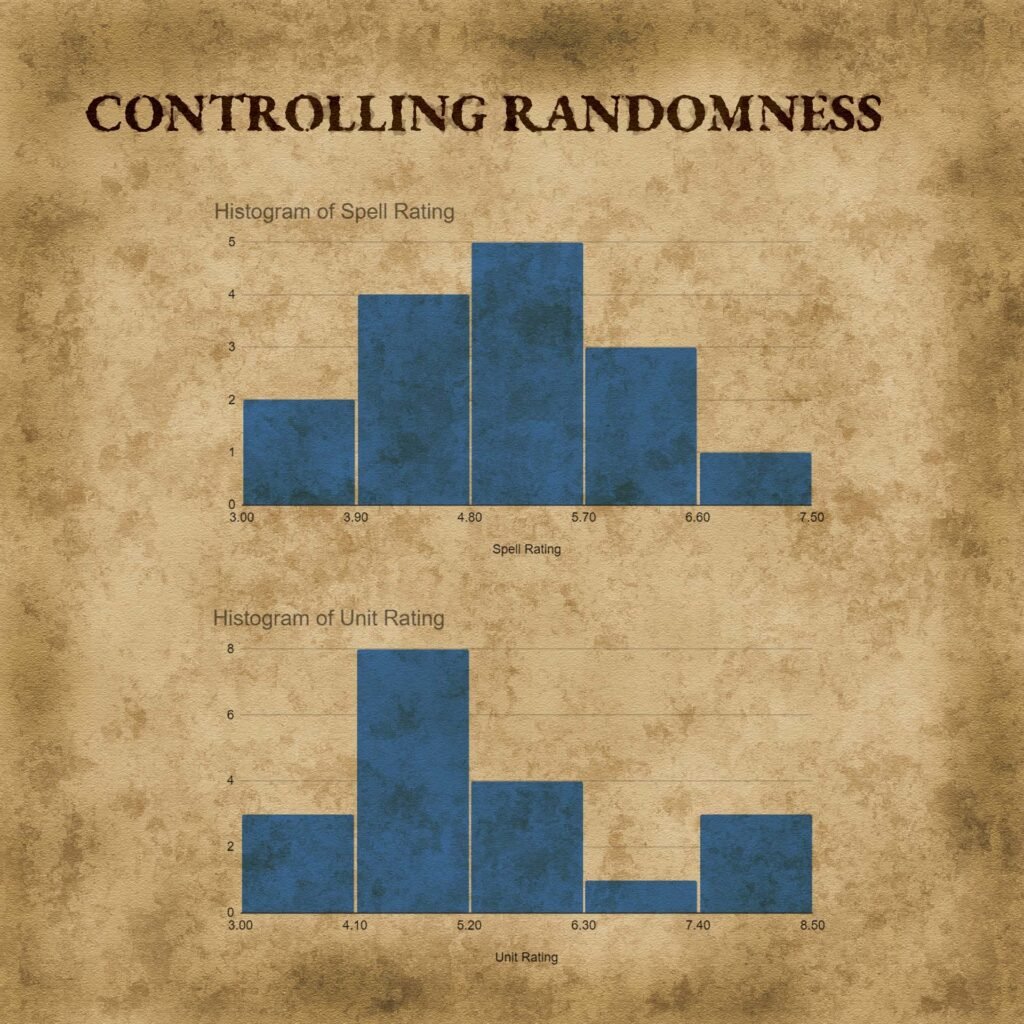
The Unit Rating Valuation helped me estimate the power level of each card. With that information, I can determine how many copies of each card I want and how many cards should be powerful and which should not.
In essence, the majority of the cards fell under a 4 – 5 Unit Rating category. This is so that the average Life of a unit falls around 1 or 2. Why so? It’s to make most spells able to destroy these units so that Players can have an overall net positive in every cycle.
Of course, there will be instances when extremes occur. During those times, it becomes the ‘surprise factor’. These are the times Players are forced to do something different. And that variance is what makes a game fun. Remember! Control what you can control, and what you can’t are just elements of fun.
Interlude
Oh my. This article went longer than I expected. Initially, I wanted to talk about balancing the overall game in general, but I ended up going more in depth about designing the balance of Legions of Kadmon’s cards instead. Sometime in the middle of writing this article, I’ve decided that it might be better to separate this into two parts. In part 2, I’ll go more in depth about designing Comeback Opportunities and how The Perfect Equilibrium does not exist. Do look forward to it!

Leave a Reply